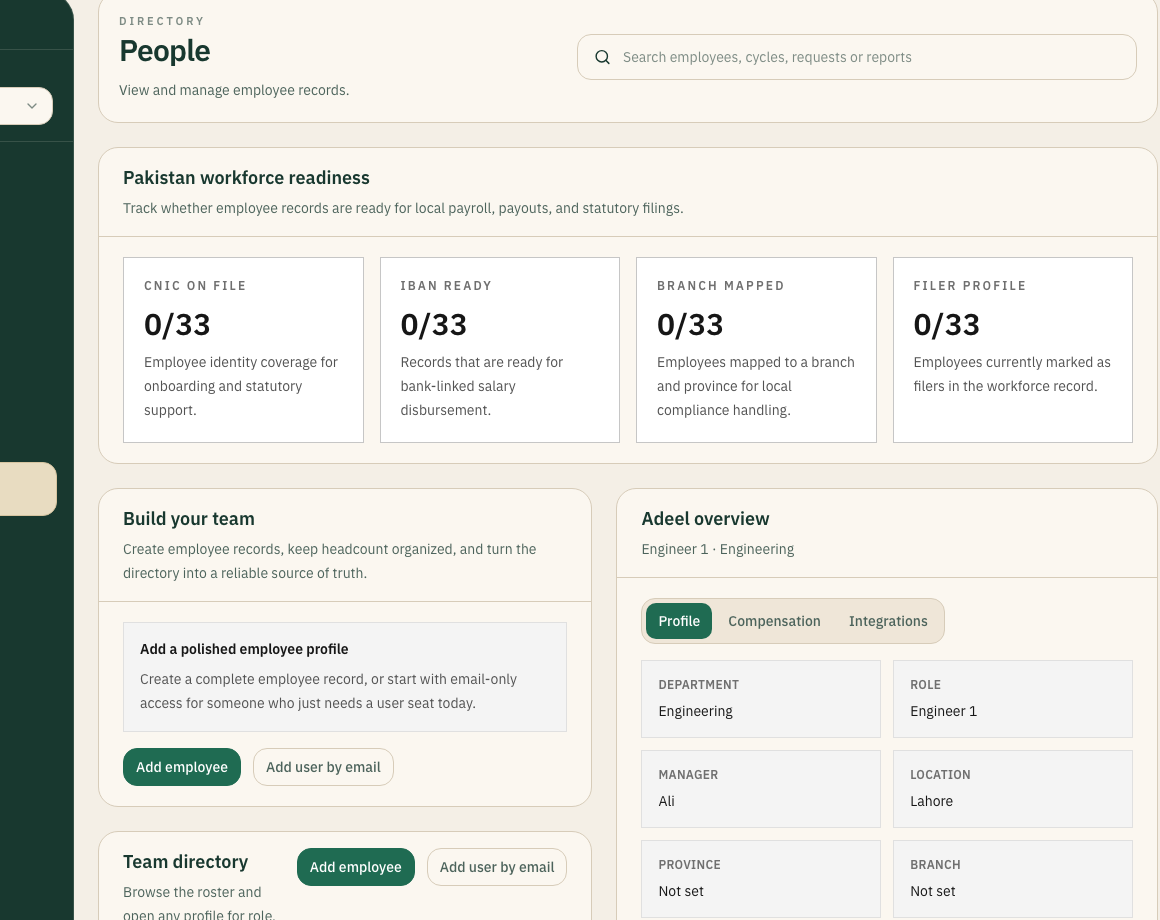
Data gaps become visible work
Compliance becomes easier when the system exposes incomplete records before they spread into payroll and reporting.
4
Sequenced steps
3
Expected outcomes
Solution
For companies that need a cleaner operational posture before the next audit, filing, or payroll deadline.
4
Operating steps
3
Expected outcomes

Compliance becomes easier when the system exposes incomplete records before they spread into payroll and reporting.
4
Sequenced steps
3
Expected outcomes
Best suited for
Surface statutory and record-quality gaps while the team can still do something about them.
The operational problem
Compliance work becomes risky when required employee data lives across files, messages, and manager memory. Missing documents and incomplete employee fields are usually discovered when an audit, filing, or internal review is already urgent.
Next move
If this route matches the problem your team is trying to solve, the next useful step is a focused conversation about rollout scope and operating fit.
ContinueScroll through the route
NxtGenSoftware keeps compliance readiness attached to the employee record. HR can see which records are complete, which documents are missing, and which branch or manager owns the follow-up.
Readiness layer
Scroll story stage


Solution
4
Operating steps
3
Expected outcomes
01 / Solution
Track profile coverage and critical employee fields directly in the operating workspace.
Required document checklist
02 / Solution
Keep the work of closing data gaps closer to the moment the records are created and maintained.
Profile completeness visibility
03 / Solution
Avoid the common pattern of reporting compliance gaps in one tool and correcting them in another.
Ownership by branch or manager
Workflow
01
Define the compliance fields and documents required for each workforce segment.
02
Track missing or outdated information directly against the employee profile.
03
Assign follow-up to HR or the relevant manager before deadlines tighten.
04
Use readiness views to prepare for payroll, audit, or internal reporting cycles.
Move the conversation forward
The useful next step is not another feature list. It is a concrete conversation about data quality, queue ownership, rollout boundaries, and the workflow that needs to go live first.