NxtGenSoftware

Use case

Standardize attendance devices

Attendance operations get harder when terminals, employee codes, and event validation live in separate places.

Device and branch mappingEmployee-code validationPunch ingestion monitoringException ownership

4

Operating steps

3

Expected outcomes

Use caseProduct route preview
Standardize attendance devices

Attendance standardization needs a process, not just hardware

The system provides a rollout path for registering devices, validating ingest, and dealing with pending events.

4

Sequenced steps

3

Expected outcomes

Best suited for

Run device rollout and punch handling with a repeatable process.

The operational problem

Attendance becomes unreliable when every location uses a different process for devices, codes, corrections, and exception review.

Next move

Standardize attendance

If this route matches the problem your team is trying to solve, the next useful step is a focused conversation about rollout scope and operating fit.

Continue

Scroll through the route

See how the operating model changes as the work moves forward.

NxtGenSoftware standardizes attendance operations by bringing devices, employee-code mapping, ingestion, and exception handling into one workflow.

Use case

Scroll story stage

Standardize attendance devices

Use case

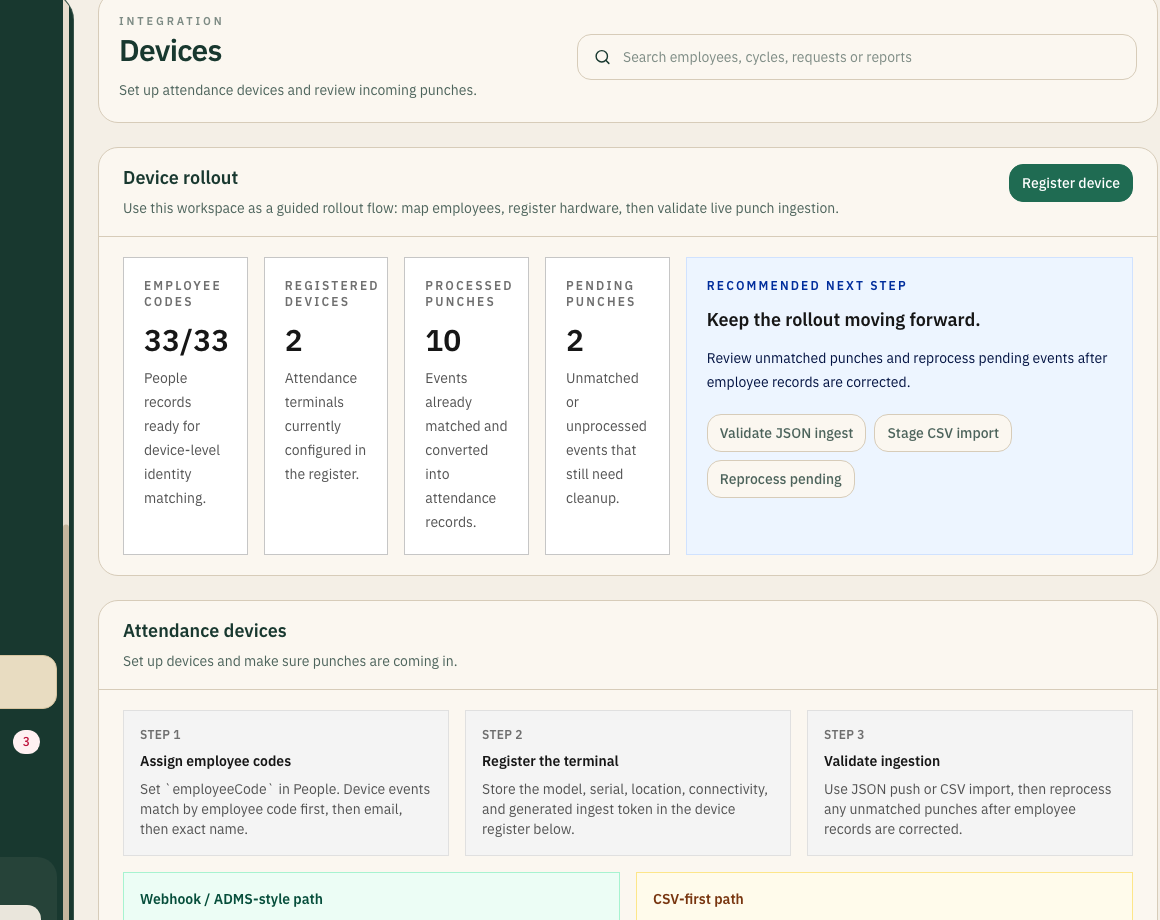
Keep rollout steps visible
4

Operating steps

3

Expected outcomes

01 / Use case

Keep rollout steps visible

Show employee code readiness, registered devices, processed punches, and pending events in one screen.

Device and branch mapping

02 / Use case

Reduce configuration guesswork

A structured rollout flow is easier to support and easier to repeat at new branches.

Employee-code validation

03 / Use case

Surface exceptions where someone can act

Pending events are only useful if the people who can resolve them see them.

Punch ingestion monitoring

Workflow

What the team actually does

  1. 01

    Register devices and assign rollout ownership by branch.

  2. 02

    Map employee codes before relying on terminal data for payroll.

  3. 03

    Review pending, unmatched, or invalid punches in a daily queue.

  4. 04

    Close exceptions before payroll preparation begins.

Move the conversation forward

Use this route to anchor a rollout discussion in the actual operating work.

The useful next step is not another feature list. It is a concrete conversation about data quality, queue ownership, rollout boundaries, and the workflow that needs to go live first.

Next step

Standardize attendance

Open next step